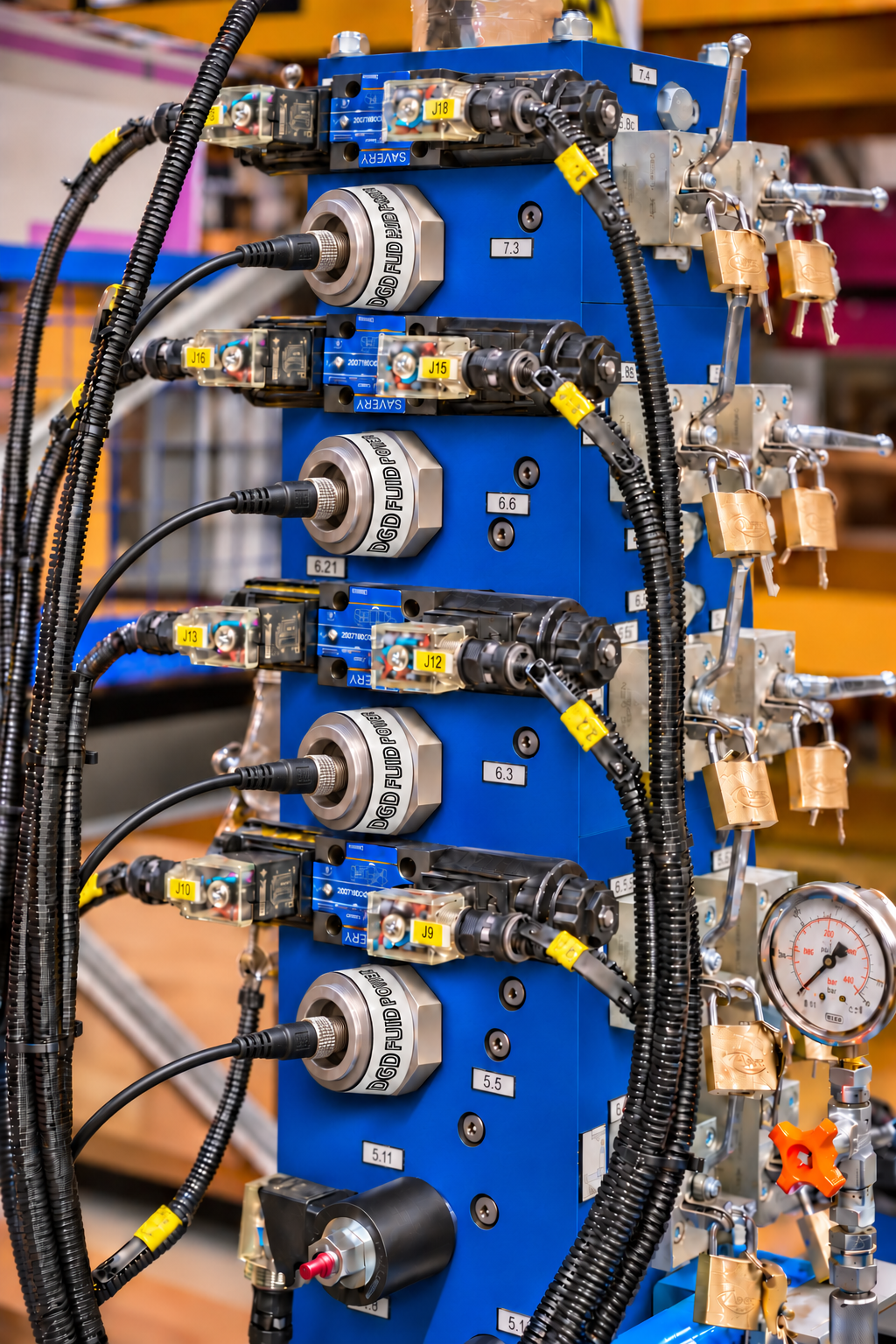
The CFT (Cartridge Flow Transmitter) is fundamentally different from a conventional inline flow meter because it is designed as a cartridge that installs directly into a custom hydraulic manifold. That compact integration is one of its primary advantages, but it also means the CFT operates within the hydraulic environment created by the manifold itself.
Every custom manifold has its own internal geometry. Port locations, passage diameters, bends, cross-drillings, valve cavities, upstream restrictions, downstream restrictions, and the proximity of other components can all influence how the oil approaches and passes through the CFT. As a result, two manifolds operating at the same actual flow rate may not produce exactly the same flow profile through the CFT cavity.
For that reason, the CFT should not be viewed as a laboratory flow instrument that can simply be installed into any manifold and expected to produce an identical absolute reading without reference to the application. Instead, it is best treated as an embedded hydraulic sensor that is scaled to the actual system in which it will operate.
During development of an application, the customer’s known or independently measured flow is used as the reference. The CFT output can then be scaled to correspond with that known flow condition in the specific manifold. Once that relationship has been established, the CFT provides a repeatable measurement that can be used by the machine or control system to monitor actual hydraulic flow and, more importantly, identify changes from the established baseline.
This application-specific scaling is not an indication of inconsistency in the CFT. It is a consequence of integrating a flow sensor directly into custom hydraulic circuitry where flow conditions cannot be assumed to be identical from one manifold design to another.
The advantage is that, once the CFT is characterized within the application, the OEM gains a compact, permanently installed flow signal without the external piping, fittings, and installation space typically required by an inline flow meter.
In practical terms, DGD’s approach is straightforward: establish the actual flow using a known reference, scale the CFT to that application, and then use its repeatability to monitor the hydraulic system over time. This makes the CFT particularly well suited for equipment monitoring, performance trending, diagnostics, and predictive-maintenance applications where changes in actual flow are often more important than laboratory-grade absolute measurement.